
True North Curriculum
At the heart of True North Classical Academy’s academic achievement is the powerful and simple truth of Core Knowledge: the more you know, the more you are able to learn. Inspired by the Core Knowledge approach developed by E.D. Hirsch, common, coherent curriculum is necessary for students to acquire the knowledge and skills they need to be successful.
The Core Knowledge sequence is predicated on two realizations. First, that a student’s ability to learn a new concept depends on what they already know, and second, that what students know is a function of previous experience and teaching. These insights, well-established by cognitive science, have profound implications for teaching and learning.
At True North, we understand that the sequence in which new concepts are taught is just as important as the scope of our curriculum. Built on the three stages of learning in the liberal arts- grammar, logic, and rhetoric- our dedicated faculty guides our students’ journey through these stages, mastering each subject’s basic facts in the grammar stage (Kindergarten to 6th grade), developing the ability to reason clearly about them in the logic stage (7th-8th grade), and finally possessing the capability to argue and support ideas creatively and persuasively in the rhetoric stage (9th-12th grade). The result is students who understand critical concepts, synthesize their learning from across subjects, and apply that knowledge in purposeful and persuasive ways, while developing a joy of learning for learning’s sake.
Grammar
In the grammar stage of grades K-6, students develop the essential building blocks for higher levels of cognitive work by engaging their natural desires to explore their world. Students take pleasure in memorization by reciting mnemonics that include historical people and events as well as famous poems and prose. Through instruction and memorization, we also ensure our students master the rules of phonics and grammar, understand foundational math facts and theorums, and are familiar with the basic elements of the natural sciences. Students also have the opportunity to engage with classic literature through the discussion of virtues present in the text and learning about the arc of a story and character development.
Logic
In the logic stage of grades 7-8, students apply the previously mastered rules of the grammar stage to the skills of reasoning, questioning, and arguing in a way that seeks what is true. Students are no longer satisfied with memorized facts, they want to know the why that lies behind the what. Instruction shifts to the Socratic Method of teaching in which students are encouraged to ask questions and follow them to their logical conclusion.
During the logic stage, students read classic literature and apply their understanding of historical time periods to enrich their comprehension, especially the United States Beginnings & Civics and Medieval History. In mathematics, students pursue either the core math pathway which includes pre-algebra and algebra or the advanced math pathway which includes Algebra I and Geometry. Within science, students study earth science, life science, and physical science or biology. In pursuit of their fullest potential, logic school students also explore the arts in courses such as observational drawing, painting, sculpture, or color theory while pursuing excellence in athletic achievement through physical education.
Rhetoric
Once a student has mastered the structure of language through grammar and how to apply what they know in their argument, thesis, or claim through the logic stage, they are ready to synthesize information and clearly articulate their understanding in a persuasive way in the rhetoric stage of grades 9-12. Students become self-motivated and self-correcting learners and are able to express themselves with clarity, depth, and originality.
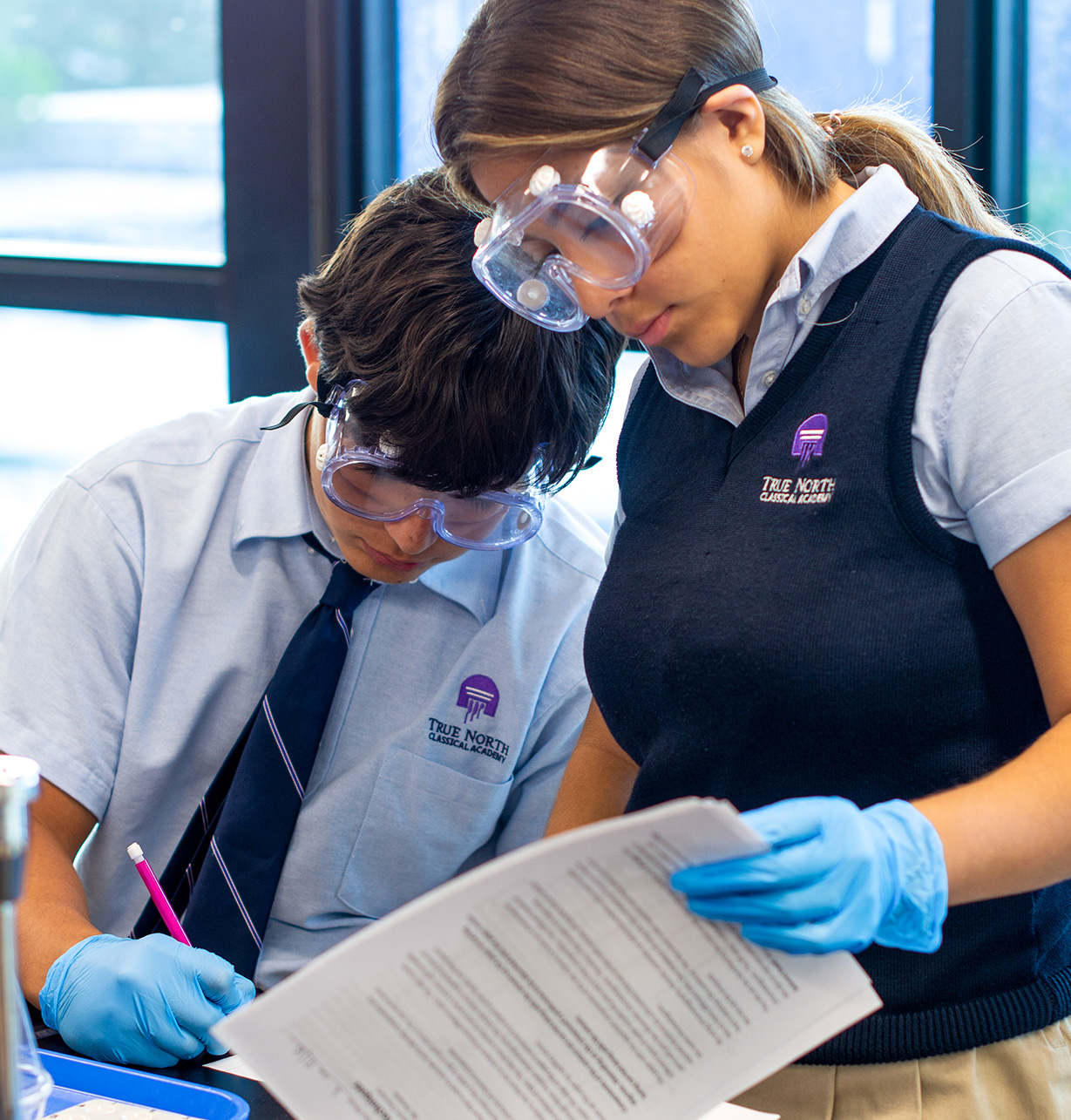
The rhetoric stage of learning brings a more formal introduction of Humane Letters. Through this approach to study, students focus on a specific time period, with each specific era exposing students to a variety of literary styles and themes while learning about the given period of history in order to make connections, contextualize their reading, and draw conclusions for a more holistic learning experience. Within mathematics, students pursue a trajectory of learning that leads to AP Calculus AB or AP Calculus BC, all the while making conjectures and learning theorems. Through science, students explore biology, chemistry, and physics, at which point they may accelerate their learning in their greatest areas of interest for upper level AP and dual enrollment courses. Throughout these courses, students partake in hands-on learning through labs to bring the theories and hypotheses of science to life.
And finally, the capstone of the 12th grade experience is the True North Senior Thesis Project that all seniors complete. Since the goal of a classical education is the pursuit of truth, beauty, and goodness, those who excel in this endeavor are able to lead others to these noble ends.
Reading Lists
Books are at the core of a classical, liberal arts education. At True North, we have a literature-rich environment and have provided each classroom with a great library of books to read in class and at home. To learn what books your child will immerse themselves in during their time at True North and why we encourage you to purchase your own set of “Classics to Keep”, please select an option below:
Please note that the books listed above include summer reading books. For additional information regarding summer learning, click here.
Summer Learning
At True North, we believe that the summer months should be an opportunity for leisure and quality time spent with family. We also believe that a healthy engagement of the mind is necessary to keep the learning of the past year fresh and to help create a bridge for the new learning ahead.
Please find below the link for your child’s summer learning work based on their relevant grade level and/or coursework.

"True happiness... is not attained through self-gratification but through fidelity to a worthy purpose."
– Helen Keller